
SOUND ENGINEERING
How Good Audio Engineers Are Changing the Industry in India
India’s music and entertainment industry is changing rapidly. Independent artists are finding audiences beyond traditional film music, regional sounds are reaching listeners across the world, and digital platforms have made music more accessible than ever.
By Ronak Runwal · November 11, 2026 · 6 min read

But behind every well-produced song, film soundtrack, advertisement, podcast, or immersive audio experience, there’s often a skilled professional making sure everything sounds right: the audio engineer.
Today, Audio Engineers are doing much more than recording vocals or operating mixing consoles. They’re shaping productions, solving creative and technical challenges, and helping Indian music compete on a global stage.
So, how exactly are good audio engineers changing the industry in India? Let’s look at the bigger picture.
They're Helping Independent Artists Sound More Professional
For a long time, the Indian music industry was heavily associated with film soundtracks and large music production houses. Today, independent musicians, singer-songwriters, bands, rappers, and electronic music producers have more opportunities to release their own work.
Digital platforms have made distribution easier, but getting music heard is only one part of the challenge. The quality of the final production still matters.
A good audio engineer helps transform an idea or demo into a finished production. This involves recording, editing, vocal tuning, mixing, mastering, and making sure the music translates well across different playback systems.
The growing reach of independent Indian music also means engineers are working with a wider variety of sounds — from regional folk influences and Indian classical instruments to hip-hop, electronic music, indie pop, and experimental productions.
As more artists release music independently, skilled audio engineers are becoming important creative collaborators rather than simply technical operators.
They're Raising the Standards of Music Production in India
Technology has made music production more accessible. Today, a producer can create an entire track using a laptop, a DAW, and a few plugins. But accessibility doesn’t automatically translate into quality.
Professional production still requires an understanding of sound, acoustics, recording techniques, signal flow, gain staging, editing, mixing, and mastering.
This is where experienced audio engineers make a difference.
They understand how to capture performances accurately, make technical decisions without compromising creativity, and identify problems before they become difficult to fix. They also know that a good mix isn’t simply about making everything louder or adding more processing.
As Indian music reaches increasingly diverse audiences, production quality and consistency become important. Engineers who understand both the creative and technical sides of music help artists deliver work that meets professional expectations.

A student running a full session from the live room.
Their Work Goes Beyond Music: Films, OTT, Gaming and Immersive Audio
The role of an audio engineer is no longer limited to music studios.
India’s expanding entertainment and digital content ecosystem has created opportunities across several audio-related fields.
Some of the areas where audio engineers are making an impact include:
Films and OTT: Dialogue editing, sound design, Foley, background scores, dubbing, and final mixing help create engaging audiovisual experiences.
Advertising: Commercials require clear voice-overs, carefully designed sound, music production, and polished audio delivery.
Gaming: Game audio professionals create sound effects, interactive audio systems, environmental sounds, and immersive experiences.
Podcasts and digital content: Good recording, dialogue editing, noise reduction, and mixing make spoken content easier to understand and more enjoyable.
Dolby Atmos and immersive audio: Engineers are exploring spatial mixing formats that allow listeners to experience sound beyond traditional stereo.
These developments are expanding the possibilities for people entering the profession. An audio engineer today can work across music, film, advertising, gaming, broadcasting, and other creative industries.
They're Bringing Global Production Standards to Indian Music
Indian music has always had a distinct identity, with an incredible variety of languages, instruments, rhythms, and musical traditions.
What’s changing is how this music is being produced, presented, and experienced.
Modern audio engineers are combining traditional musical elements with contemporary production techniques. They might record acoustic Indian instruments using carefully selected microphones, blend live performances with electronic production, or create mixes that work across international streaming platforms.
The growth of independent Indian music is also creating more opportunities for cross-border collaborations and global audiences.
According to Spotify’s 2026 Loud & Clear report, royalties generated by Indian artists on the platform grew by 29% in 2025. The report also highlights the growing international discovery of Indian artists.
This is an encouraging sign for the wider music ecosystem. As Indian artists reach more listeners, the demand for skilled producers, recording engineers, mixing engineers, and mastering professionals becomes increasingly important.
Good audio engineers help ensure that the music retains its identity while meeting the technical expectations of modern distribution.
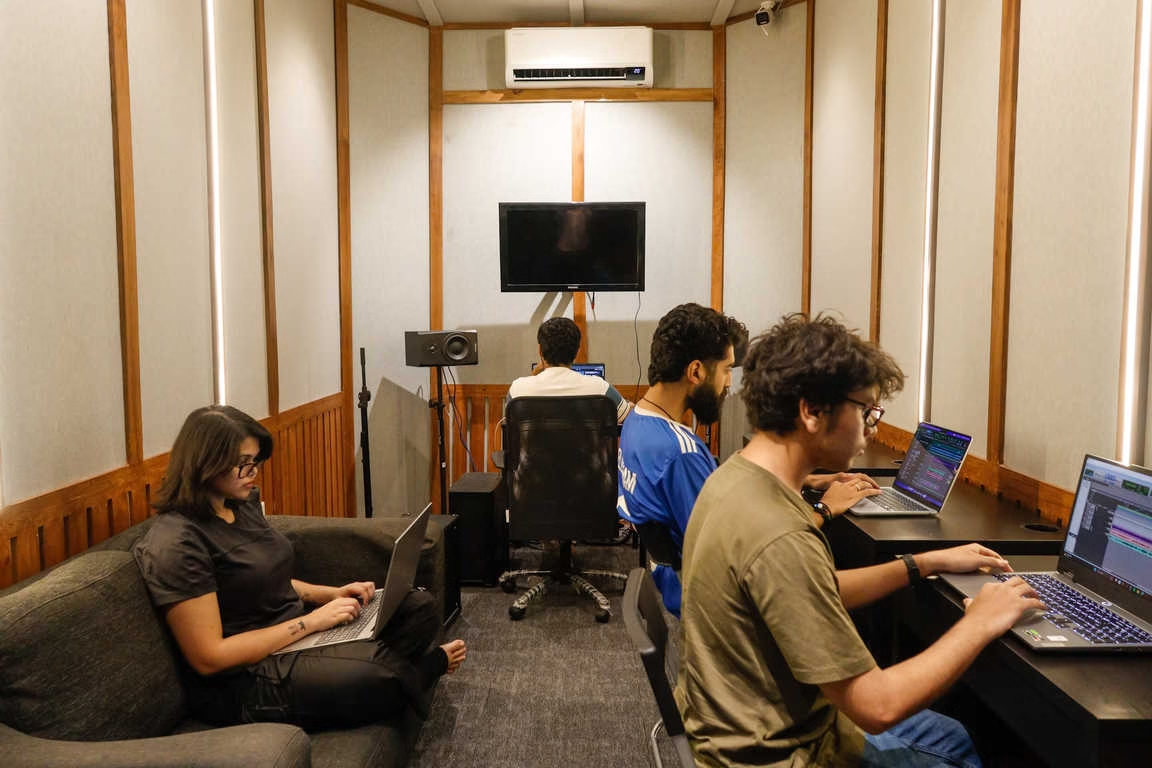
Students at Gray Spark Audio Academy
Why the Next Generation of Audio Engineers Needs Practical Training
As the industry grows, the need for skilled professionals grows with it. But becoming a good audio engineer requires more than knowing how to use a DAW or having access to expensive plugins.
It requires practical experience, critical listening, problem-solving, communication, and an understanding of how professional studios and production environments operate.
This is why choosing the right education matters.
Students exploring a course music production, music production courses, or music production classes should look beyond the software being taught. They should understand whether the learning environment provides opportunities to work on real projects and develop practical skills.
Similarly, those considering sound engineering courses, a music engineering course, or a studio engineering course should look for training that covers the complete audio production process — from recording and editing to mixing, mastering, and professional studio workflows.
When comparing the best audio engineering colleges in India or exploring sound engineering courses in India, it is worth asking a few important questions:
Do students get hands-on experience with professional recording equipment?
Are they learning in an actual studio environment?
Do they work on real music and audio projects?
Are they developing critical listening and problem-solving skills?
Do they understand professional workflows and client requirements?
Whether you’re looking for a music making course, producing music classes, or courses for audio engineering, the goal should be to develop skills that translate into actual industry work.
At Gray Spark Audio Academy, we believe students learn best when they get to work in a real studio environment. Our approach combines technical learning with practical experience, allowing students to understand not just how audio tools work, but how they are used in professional projects.
The Future of India's Audio Industry Needs Better Engineers
The Indian audio industry is moving into an exciting phase. New technologies, independent music, regional content, gaming, immersive audio, and digital platforms are creating opportunities that didn’t exist in the same way a decade ago.
Artificial intelligence is also changing parts of the production process, making certain tasks faster and introducing new creative possibilities. But technology still needs people who understand sound, can make informed decisions, and know how to bring a creative vision to life.
The future won’t simply belong to people who know the latest software or own the best equipment. It will belong to professionals who combine technical knowledge with creativity, adaptability, and practical experience.
Good audio engineers are already helping shape that future. They’re giving independent artists a professional sound, contributing to better films and digital content, exploring new audio formats, and raising expectations across the industry.
Why Gray Spark Audio?
At Gray Spark Audio, we believe the future of the industry depends on both great audio professionals and the next generation of talent learning the craft properly.
If you’re interested in building a career in music production or sound engineering, explore the practical learning opportunities at Gray Spark Audio Academy.
Because the future of Indian audio won’t just be created by the people making the music. It will also be shaped by the people who know how to make it sound right.
VISIT THE STUDIO
Want to set up a meeting at our facility?
Come see the rooms, meet the faculty, and get a feel for how we train. Our next batch begins June 2027.
Join the newsletter for course updates and open-studio dates.
Keep reading
Career
How to Build a Sound Engineering Portfolio That Gets You Hired
5 min read
Studio
Microphone Placement Basics Every Beginner Should Know
7 min read
Industry
Careers in Audio: Where Sound Engineers Work in 2026
6 min read
Grayspark Audio Academy
PUNE, INDIA
© 2026 Grayspark Audio Academy. All rights reserved.
GRAYSPARK CONTENT BLOCKS
Your block kit
Every block below is already styled in the blog’s design. In the Elementor editor, right-click any block → Copy, then right-click where you want it in your post → Paste. It keeps the fonts, colours and spacing. Delete or duplicate freely. (You can also drag blocks to reorder them.)
Heading (H2)
Your section heading
Subheading (H3)
A smaller subheading
Category / eyebrow label
CATEGORY LABEL
Body paragraph
Your paragraph text goes here. Replace it with whatever you’re writing — it keeps the body font and spacing automatically. You can bold words or add a link.
Pull quote
A short, punchy pull-quote that stands out from the body copy.
Image + caption

Image caption — edit or delete me.
Full-width image
Two images side by side
Tip / callout box
Tip
Use this box to highlight a key takeaway, a note, or a quick piece of advice.
Step flow strip
A short flow
Step one → Step two → Step three → Step four